
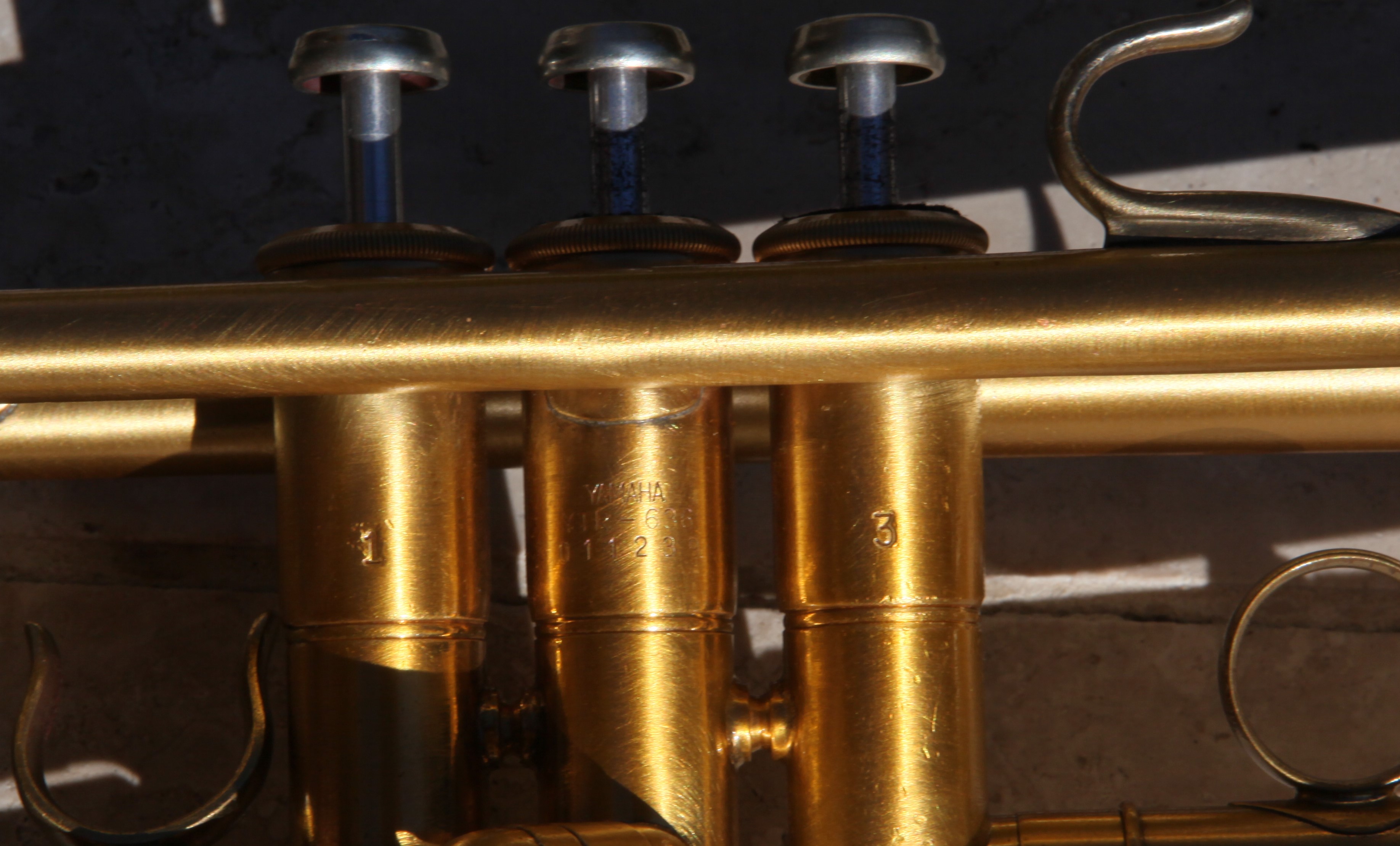
Before and After: Yamaha YTR-636 - Late 1970s - Brushed with Gold Epoxy Lacquer Finish
SOLD: In 1966, Yamaha hired Renold Schilke to consult is the design of a line of trumpets. This relationship continued until Schilke's death in 1982 where the Yamaha line implemented many of the design specifications and trade secrets provided by Schilke. The YTR-636 was Yamaha's lacquered version of the Schilke B7 (Jon Faddis played the B7 for years) and was among the first "step-bore" designs made by Yamaha. While it is technically classified as a "medium bore," .445" at the 2nd valve, the tubing through the tuning slide up to the entrance to the 3rd valve is .459" Additionally, the YTR-636 features an "A style" bell which is a "large bore bell" which measures 5" at the bead. This combination, or step-bore design provides a component of "compression" at the valve, while maintaining an open feel, particularly due to the large bell tubing and taper. The sound of the YTR-636 has a big fat core accompanied by rich overtones. It reminds me a bit like the classic sound of a Martin Committee. It has a light-weight bell that sizzles at high volume and in the upper register. The YTR-636 model was played by great lead trumpeter Roger Ingram. The valve compression is high with good 'pop' after activating the slides and pressing the valve. Intonation is excellent and slotting is a good balance between solid slots and ease of flexibility. It is really fun to play in both a lead-situation and in an intimate small combo. Incidentally, these early step-bores were the basis of the popular YTR-6310Z which was the first Bobby Shew "Z horn." This horn is refinished by hand intentionally leaving some imperfections rather than removing material to make it look "new." (Small amount of wear visible on the outside of the valve casing.) These imperfections have no impact on the playing performance of the horn. It is hand-brushed and finished with gold lacquer. We understand that an instrument of this caliber requires scrutiny of play-testing to evaluate compatibility between the horn and the player.