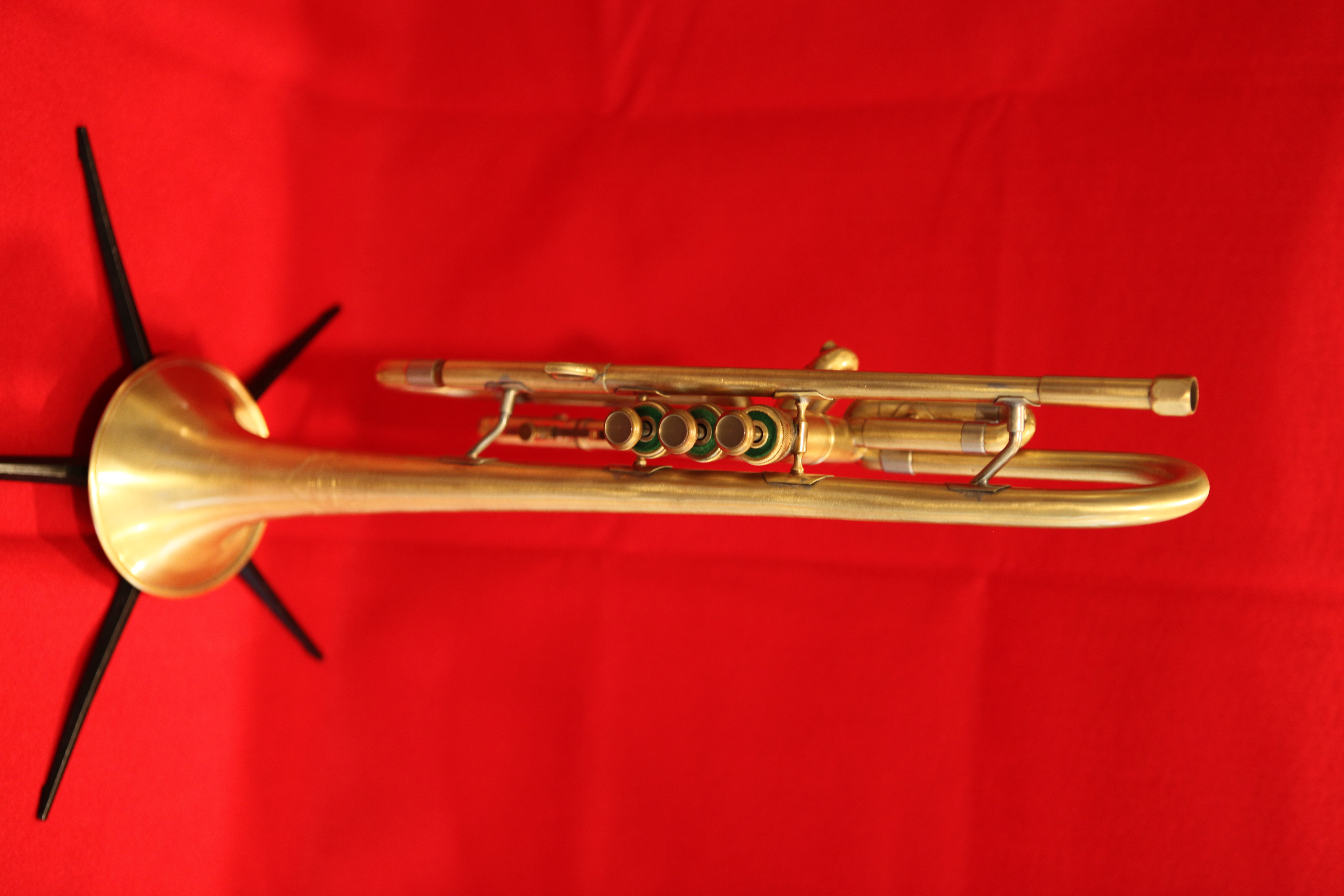
Before and After: Olds & Sons Ambassador 1971 Brushed and Finished with Clear Epoxy Lacquer
Only recently, had I begun to understand the craftsmanship that went into the design and production of the Olds Ambassador Trumpet. My only contact with the instrument was back in the 1970s when I was in school and fortunate enough to have a Bach Stradivarius while other kids had to play on an Olds Ambassador. What I didn't know was just how good the Olds Ambassador was... until recently. When we finished the re-build of our first specimen (this particular horn) and play tested it, we were astonished at how sturdy the horn was, how perfect the intonation was, the incredible response, the openness of the blow and the sound! The sound has a nice narrow core, but with a rich and sophisticated quality to the tone. Furthermore, the upper register centers easily for me up to double C with increasing sizzle. I kept asking myself, "how could these qualities be present in a student instrument that was made almost 50 years ago?"
Here is what I learned from an exerpt from feolds.com: In the late 1940s, in a meeting between Reynolds, Reg Olds and Berlin, it was decided to pursue the student musician market for which great projections had been made. Among his first design actions were the renowned Ambassador model trumpet, cornet and trombone (1948). In fact, the trumpet was designed in tandem with the Mendez professional model. Because Olds management was concerned about the possible effects of a low-priced model on the company’s reputation, Reynolds insisted the horn be built to the same quality and tolerances of the rest of the line, only with less-expensive bracing and other features. According to R. Dale Olsen, who was R&D director at Olds in the 1960s, the company was a “one tolerance shop,” meaning that all brass instruments were crafted to the same close tolerances, regardless of price or market niche.
Indeed, the Ambassador model is a diamond in the rough. We did some measurements to learn that the leadpipe venturi is very large at .351" generating awesome response and intonation - the bore at the 2nd valve is ML at .460" and the long bell tail, exiting the first valve, provides decent compression so the blow doesn't feel too open. All together, these features make a great playing horn. I have enjoyed it so much, I have used it on gigs and will again this weekend.
For the professional and the student alike, this horn is a gem. As you can see from the pictures, when we put the horn back together we tilted the bell up, ever so slightly, to give it a little Dizzy "attitude."