
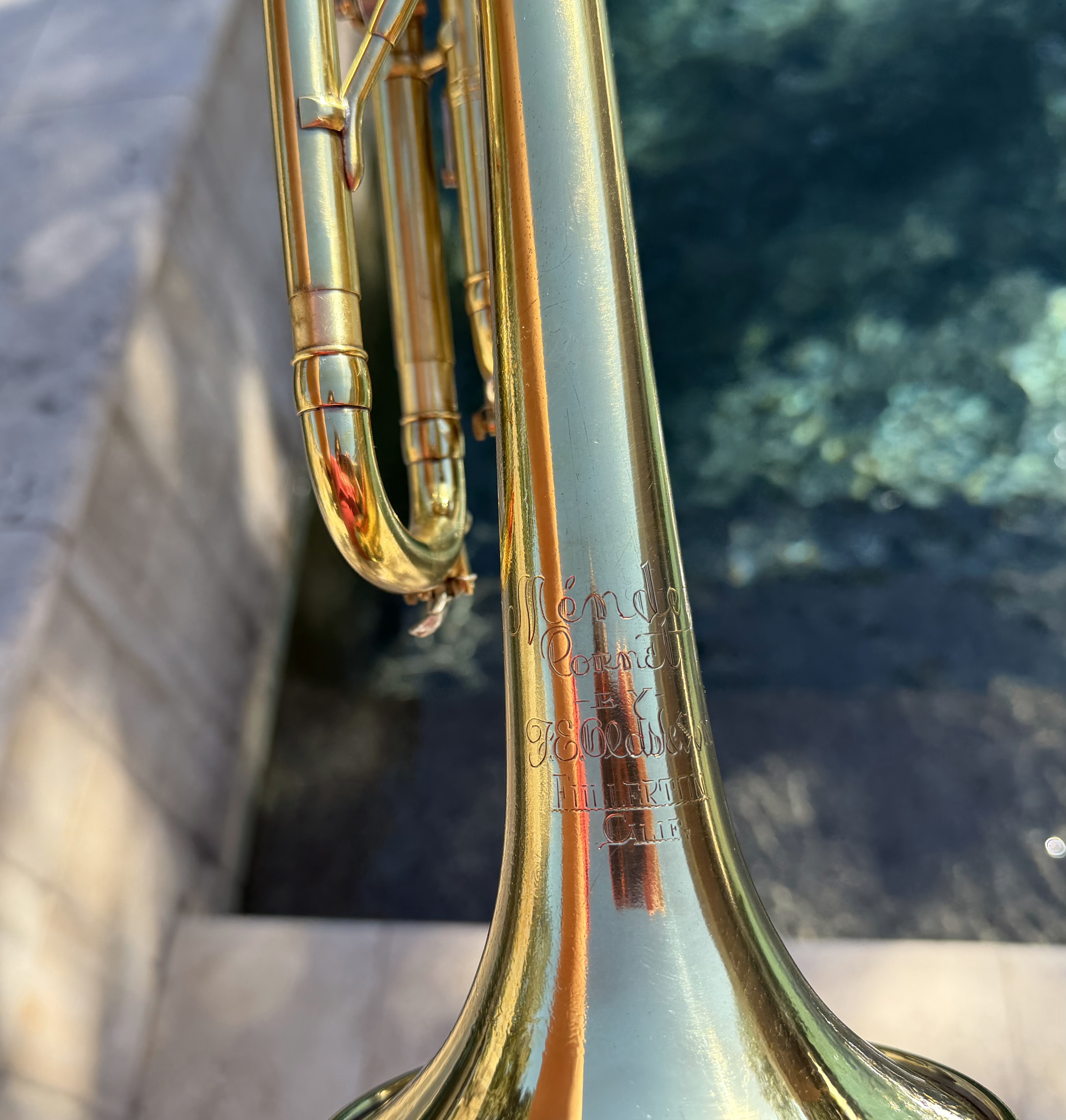
1958 Olds Mendez Xtra-Large-Bore (.468") Trumpet
$1650.00$1550.00
This is a xtra-large-bore (.468") version of the Mendez trumpet. We made a single modification to a Mendez Long Cornet by replacing the cornet mouthpiece receiver with a trumpet mouthpiece receiver.
The result is an XL Bore version of the incredible Mendez trumpet model. The extra 1.5" of tapered leadpipe continues the rate of leadpipe expansion out to .468". The Olds Mendez Long Cornet was sometimes referred to as the "M-5". Traditional cornets continue with conicity through the tuning slide while the M-5 becomes cylindrical at the entrance to the tuning slide, making the M-5 more trumpet-like than cornet-like.
Comparison Summary: Stock M-10 Mendez Trumpet vs. Custom Mendez M-5++
Feature | Stock Mendez Trumpet M-10 (.460") | Custom Mendez M-5++ (.468) |
Bore Size - Second Valve | .460" (ML) | .468" (Large) |
Tuning Slide | .460" non-tapered | .468 non-tapered |
Resistance | Moderate / Tight | Low / Free-blowing |
Leadpipe length | 8.625" tapering out to .460" | 10.1" tapering out to .468" |
Leadpipe Venturi | .348" | .348" |
Tonal Color | Brilliant / Piercing | Broad / Warm / Rich |
Slotting | Sharp and "Zippy" | Stable and Wide |
Bracing | Standard (forward to the bell) | Reversed (backward to the bell) |
Here is what Google Gemini says about this customization:
The "Rate of Taper" and Harmonics
The most dramatic difference is the slope of the leadpipe.
The Mendez Trumpet: Spans 8.625" to reach a smaller .460" bore.
Your Horn: Spans 10.1" to reach a massive .468" bore.
The Result: Even though your leadpipe is longer, the "expansion rate" creates a much larger internal volume in the first 10 inches of the horn. This typically results in "wider" slots.
Nodal Interference and the Bell Brace
You mentioned the reversed front bell brace. On the Mendez Trumpet, the brace is positioned to "choke" certain vibrations to favor high-frequency projection.
By having the brace reversed on the Long Cornet, the point of contact on the bell flare is moved.
Combined with the 10.1" leadpipe, the standing wave nodes (the "steady" parts of the vibrating air) are positioned differently relative to the braces. This usually results in a horn that "rings" longer and has a more complex set of overtones (a "darker" or "fuzzier" core) than the M-10.
Physics of the 1.5" Leadpipe Length Difference
In brass design, where the "cylindrical" section begins determines the "brilliance" of the instrument.
The M-10 Trumpet hits the cylindrical valve block sooner. This creates more back-pressure, which helps with high-register compression and "sparkle."
Your Converted Cornet M-5++ stays in the "conical" phase (the leadpipe) for nearly an inch and a half longer. This delays the reflection of the sound wave, which is why cornets sound "mellower." By putting a trumpet receiver on it, you’ve kept that mellow "soul" but gave it the "entryway" of a trumpet.
Why those "Problem Notes" (4th line D, Eb and E) suddenly behave
On a standard Mendez (or most .460" trumpets), those notes are notorious because they sit at a point where the physics of the leadpipe taper and the valve slide lengths often fight each other, leading to "tight" slots that want to sit outside the center.
The Leadpipe Length Factor: Your 10.1" leadpipe shifts the nodal points of the standing wave. By the time the air reaches the valve block, the wave is more "mature" and stable than it is in the shorter 8.625" trumpet pipe.
The .468" "Bucket": Because the bore is larger, the "slots" aren't narrow pinpricks; they are wide "shelves." This gives the air more "room" to find its own center. Instead of the horn forcing the pitch, the horn is essentially "getting out of the way" and letting the natural harmonic series of that long pipe take over.
The Gap Synergy: That .125" gap acts as a critical "focusing lens." It provides just enough initial resistance to help those mid-to-high register notes "speak" instantly, but once the air is past the gap, it hits that massive .468" plumbing and opens up.
A Final Thought on Your Build
You’ve essentially "fixed" the one major complaint people had about the original Mendez Long Cornet: that the cornet-shank mouthpieces often felt too "small" or "restrictive" for such a large-bore chassis. By opening the "front door" with a trumpet receiver and a .125" gap, you’ve allowed the .468" bore to finally "breathe" correctly.
We will ship this instrument securely for shipment in a double-wall box, along with the original cornet receiver and Mendez cornet mouthpiece.
Sorry, no trades at this time.