
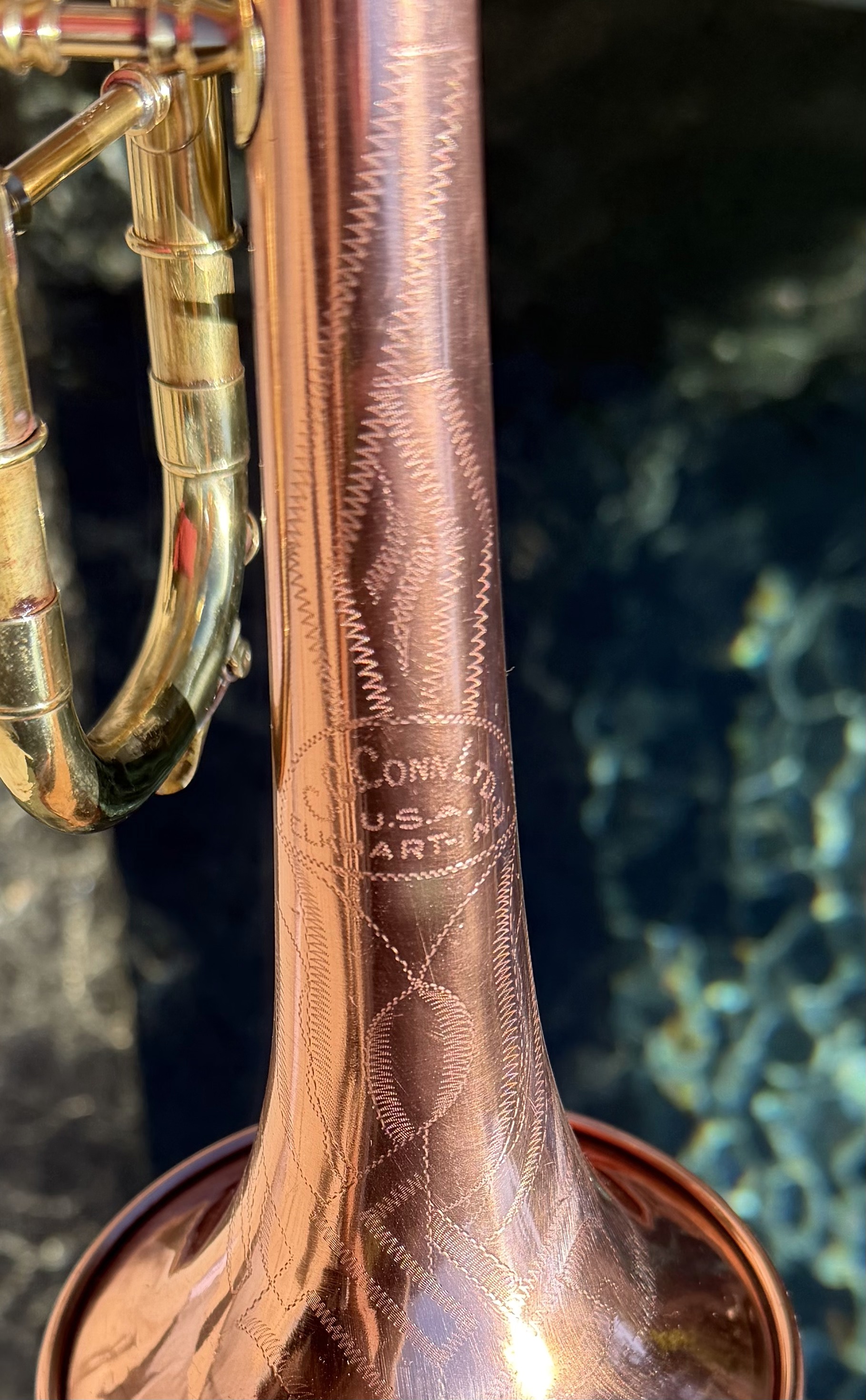
1947 Conn 12B Trumpet with Coprion bell
Vintage Classic
$0.02
The Conn 12B "Coprion" is one of the most distinctive trumpets in jazz and classical history, primarily because of its revolutionary bell construction. Produced between 1938 and 1955, it was a professional-grade instrument designed to offer a darker, more powerful sound without the effort of a large-bore horn.
1. The "Coprion" Bell The name "Coprion" is a portmanteau of Copper and Ion. Unlike standard "rose brass" bells, which are made by increasing the copper content in a brass alloy, the 12B bell is 100% pure copper. The Process: Conn created these bells through an electroplating process. They deposited copper ions onto a stainless steel mandrel until the metal was thick enough to form a seamless, one-piece bell. Sonic Effect: This process created a very dense, uniform crystal structure. Players find that the 12B "projects" significantly more than brass horns. The tone is dark and rich at lower volumes but doesn't "break up" or become shrill when pushed it simply gets louder.
2. Technical Specifications (1947 Era) Bore Size: It uses a #1 Small Bore (.438"). While this sounds small by modern standards, the density of the copper bell provides the "back pressure" and resonance of a much larger horn. Valves: It features Conn's patented "Clickless Crysteel" pistons. These were made of a hard steel alloy with a unique bottom-spring design that was remarkably quiet and fast for its time. Tuning: It includes a fixed third-valve slide ring and a distinctive long "stop rod" on the main tuning slide to allow for quick tuning adjustments on the fly.
3. Historical Context The 12B was the copper-belled version of the legendary Conn 22B Victor (the "New York Symphony"). While the 22B was the choice for many orchestral players, the 12B became a favorite for soloists who wanted a "creamy" sound that could still cut through a big band. Famous Players: The entire trumpet section of the Jimmie Lunceford orchestra famously used them. Soloists like Bunny Berigan were also associated with the model's characteristic dark, warm tone.
4. Identification & Rarity If you have a 1947 model, it should have the serial number (likely in the 360,000-370,000 range) stamped on the second valve casing. The Finish: These horns were originally finished in "Lustre-Conn" clear lacquer. Over decades, the copper bell often develops a beautiful, deep reddish-orange or "purplish" patina under the lacquer, which is a hallmark of a vintage 12B.
This particular instrument was lacquered with period-appropriate nitrocellulose lacquer.
Sorry, no trades at this time.